I Misread Who Was in the Shot. Three Faces Settled It
I mistook hands for sword handles and identified the wrong character. Comparing three enlarged faces corrected my reading.
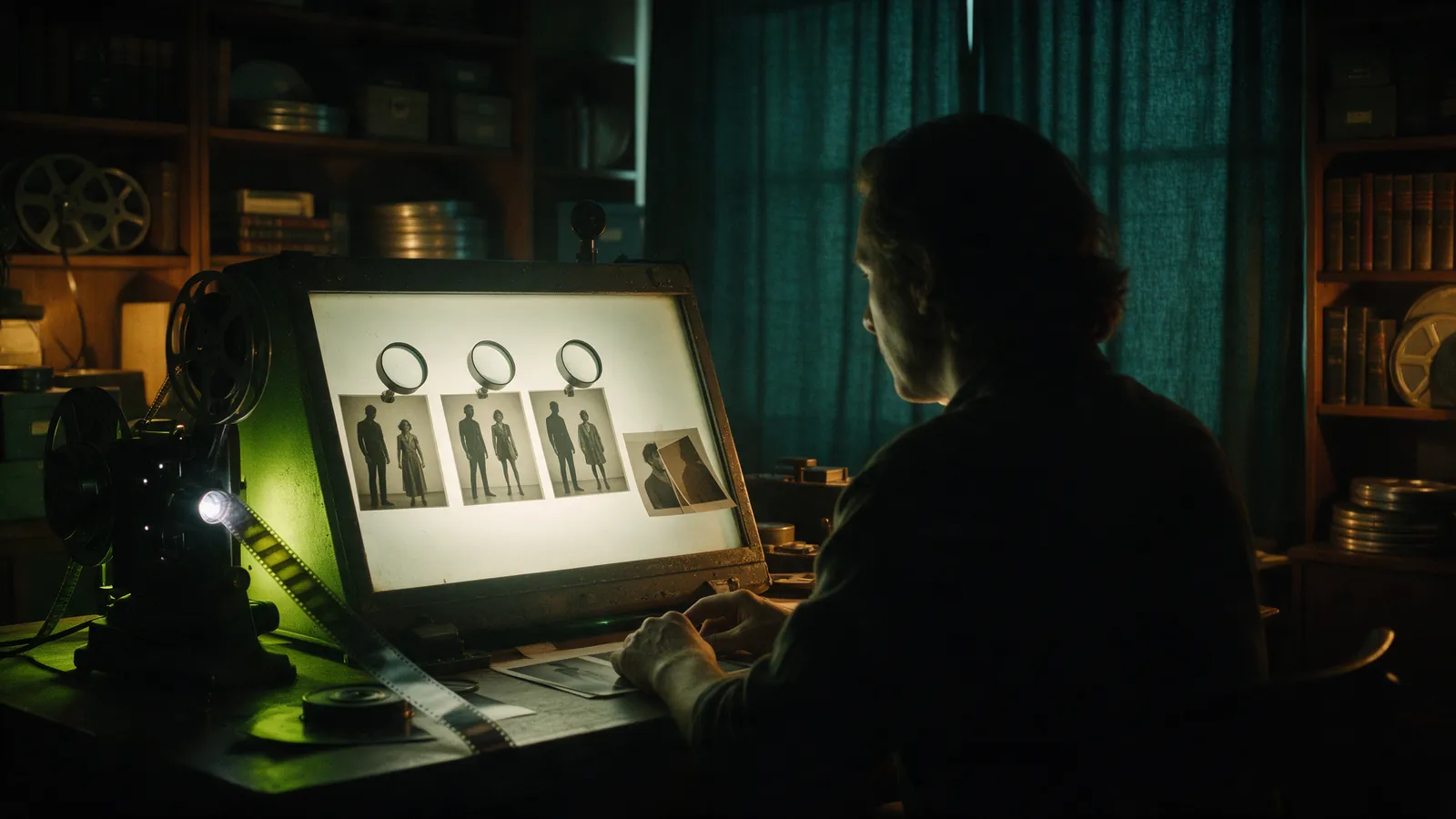
Three cropped, enlarged faces overturned what I had called the most serious failure in my film.
I had identified the standing man in a shot as the wrong character. From that identification, I accused the central scene of failing. When I compared the faces side by side, the accusation did not hold.
The familiar concern behind my mistake was reasonable: if a character seems to change between shots, the scene deserves a closer look. I still believe that.
What I no longer accept from myself is treating “seems different” as a completed identity check. In this case, I had enough visual information to form a suspicion. I had not examined the information that could settle it.
What I thought I saw
Ino Tabe sings while kneeling, receives Sagi’s cuts, bleeds, and falls face down into the sand at 5:54.
The film cuts. In the following shot, beginning at 5:57.70, a man stands facing the camera. He stays still for four seconds.
I decided that man was Mabe.
My reason was down at his hips. I saw two long, dark shapes and read them as the handles of two swords. That reading became my identification of the person.
The shapes were his hands, with the folds of his sleeves falling around them.
That was the failure. I had interpreted an ambiguous detail incorrectly, then allowed that interpretation to support a much larger claim about the scene.
The cost I can establish is the false criticism itself. I had labeled the sequence as the film’s most serious problem. I cannot attach an amount of wasted time or money to it. I can say that my assessment of the central scene was wrong.
The fair version of the concern
If you make AI video, “this character looks different between shots” is a concern worth checking. I would not tell you to dismiss it because my own reading was mistaken.
My objection is narrower. A visual impression needs a comparison before I treat it as proof.
I had looked at the standing figure and reached a conclusion through the shapes near his hips. That might have been enough to flag the shot for review. In my judgment, it was not enough to identify him confidently.
The difference matters because the next question changes with the identification.
If the standing man is Mabe, I read the sequence one way. If he is Ino, the sequence shows the fallen character standing after the cut. I needed to settle that factual question before judging what the edit meant.
Instead, I had built my criticism on the answer I assumed.
Three faces made the comparison specific
The correction came from placing three cropped and enlarged faces next to each other.
The first was Ino, identified by his prayer on screen. The second was the standing man. The third was Mabe, identified by his dialogue.
Those reference points mattered. I was comparing the disputed face with faces attached to identifiable characters.
The standing man had Ino’s broad face and the same jaw. Mabe had a longer face and more widely spaced eyes.
With the three faces together, the identification was clear: the standing man was Ino.
That established the character in the shot. It did not establish anything about an actor’s identity, and I do not need to make that claim to resolve the scene.
The comparison answered the question I had actually needed to ask: was the man standing after the cut the same character who had fallen?
Yes. My reading of the hands had led me away from the face.
Correcting the identity changed my reading of the cut
After the standing shot, the herald announces that Ino Tabe has risen and that Ryo Sagi is therefore defeated.
Once I had corrected the identification, that announcement fit what the image had shown.
The cut carries the change from collapse to standing. The film does not show the effort of getting up. In my corrected reading, that omission is an effective choice. I find it more elegant than showing the whole action.
It also matches the rule announced at 2:10.
That is an interpretation I can now defend from the sequence. Before the face comparison, I was criticizing the same edit through a mistaken identification.
I find that uncomfortable in a useful way. My confidence had been strongest when my check was weakest. Calling something the most serious failure in the film did not make the underlying observation more reliable.
What I would check before changing a shot
I would keep the initial concern. The standing figure did prompt a question, and checking it was worthwhile.
I would change the order of my judgment. First identify the person using clear references. Then assess whether the sequence communicates the action.
For this scene, the face comparison was enough to correct me. I would not turn that into a claim that every apparent character difference has the same explanation. My mistake involved hands, sleeve folds, and the wrong identification. Another shot would need its own examination.
I also would not claim that the size of the original image caused my error. I misread the image, and the comparison resolved it.
Today, take one shot where a character seems different, crop and enlarge that face, and place it beside clearly identified reference faces before deciding the shot needs a repair.
The easy post agrees with everybody. This one didn't, and some days the thing I argue against is my own work.