How to Use Four Variations to Diagnose an AI Shot
Treat four AI video variations as a diagnostic batch, inspect every frame, and salvage the usable seconds before regenerating.
The first four variations are not my attempt to finish the shot. They are my diagnostic batch.
That distinction changed how I review generated video.
If I expect one of four outputs to be perfect, I judge the batch as a set of winners and failures. If none survives untouched, I assume I need another generation.
A diagnostic batch asks a different question: what did the machine understand, what did it fail to resolve, and which seconds are already usable?
That makes the first four outputs the cost of deciding what to do next.
Start with one short, surgical shot prompt
The production method separates two layers of prompting.
The master document can be long. It holds characters, wardrobe, location anchors, style, and prohibited elements.
I keep the prompt for one shot below 400 characters, even when the larger production document is much longer.
This matters during diagnosis. If the shot prompt tries to contain the entire project, a failed result does not tell me which instruction caused the problem.
I want a compact prompt that lets me compare four outputs against the same clear request.
The prompt describes the situation and the visible behavior of the body. It does not depend on an emotion word to create a readable performance.
Instead of naming a feeling, I describe what the body does: the walk slows, the hands drop, or the person freezes.
That gives me something visible to inspect in each variation.
Use photographic instructions that can be checked
I remove broad quality labels such as “cinematic” and “high quality.”
Those words do not give me a precise result to compare across four clips. Photographic vocabulary does.
The shot can specify an anamorphic lens, grain, halation, or a closed aperture. The practical light should be named and visible in the frame, such as the sun, a window, or a lamp.
Natural-light prefixes were also used to reduce the machine’s typical overexposure.
When I inspect the four variations, I can now ask direct questions. Is the practical light present? Is the frame overexposed? Does the chosen photographic treatment appear consistently enough to use?
The batch becomes evidence about how the prompt was interpreted.
Write the physics into the request
Generated objects can expose a shot immediately.
The verified prompting method used the literal instruction “no floating props” to remove weightless object behavior.
That sentence is useful because it creates a binary review condition. Either the objects obey the expected physical relationship, or they do not.
I check that condition across all four variations. If the same physical failure repeats, I have a prompt-level problem to address. If it appears only in part of one clip, I may still have usable material elsewhere in the batch.
The point is not to make one global judgment about each variation. It is to locate the exact frames where the shot stops working.
Break a changing shot into timed sections
A single prompt can contain multiple beats when those beats are marked by time.
For example:
[0 to 2s] She walks in. Door closes. She doesn't look up.
[2 to 5s] She sees him by the window. Her walk slows. Her hands drop.
[5 to 8s] She freezes. Not afraid, paralyzed by recognition.
This structure lets dialogue or performance changes happen without creating a new shot.
It also gives the review a clear order. I can compare the opening section across four variations, then the middle section, then the final section.
One output may have the best entrance. Another may have the cleanest recognition beat. A third may hold the final pose without corruption.
That does not automatically make any full clip usable. It tells me where the usable seconds are.
Check the camera before the performance
The method avoids a frontal camera because it flattens the image.
The available alternatives include three-quarter views, a high security-camera angle, a corner composition, and a Dutch angle. The frame should have depth.
I check this early because a readable performance cannot repair a camera position that fails the intended composition.
Across the four variations, I look for the version that best maintains the requested angle and spatial depth. Then I inspect whether that version also survives anatomically and physically.
The diagnostic batch is not a beauty contest. A striking frame is not enough if it cannot hold together through the clip.
Check the color ratio as a composition
Color can also be specified in measurable proportions.
The method uses a 60:30:10 structure: the dominant color occupies 60 percent of the frame, the secondary color 30 percent, and the accent 10 percent.
I do not need every generated frame to behave like a mathematical diagram. I do need the intended hierarchy to remain visible.
If the accent takes over a variation, the composition has changed. If the dominant color disappears, the shot no longer follows the requested balance.
Comparing four outputs shows whether the color instruction is stable or whether the next prompt needs to state the elements carrying each part of the ratio more clearly.
Verify the character state
Identity is only one part of character continuity.
Before each scene, the method tracks current injuries, damaged clothing, props, and anything missing.
The face reference also needs careful preparation. The method calls for cropping the face from the full-body sheet before upload so the identity anchor is controlled.
I check all four variations against the current character state. A good facial match does not excuse intact clothing that should be damaged. A correct injury does not save a corrupted face.
This is where batch review prevents wishful thinking. A variation can contain several correct decisions and still fail continuity.
Those correct decisions remain useful diagnostic evidence. They show which instructions the model retained and which ones need reinforcement.
Verify the location through its anchor
Location continuity uses a fixed reference object.
Every character is positioned relative to that object in each prompt. Before shooting a scene, the method prepares an exterior, a general interior, an alternate interior angle, and detail views. Complex scenes also get a top-down floor plan.
That preparation gives the diagnostic batch a spatial standard.
I can compare where the character appears relative to the anchor. I can check whether the alternate camera still belongs to the same interior. I can see whether the motion respects the planned space.
Without the fixed object, four variations may provide four plausible rooms. With it, I can judge whether they depict the same location.
Review every frame
This is the part I cannot skip.
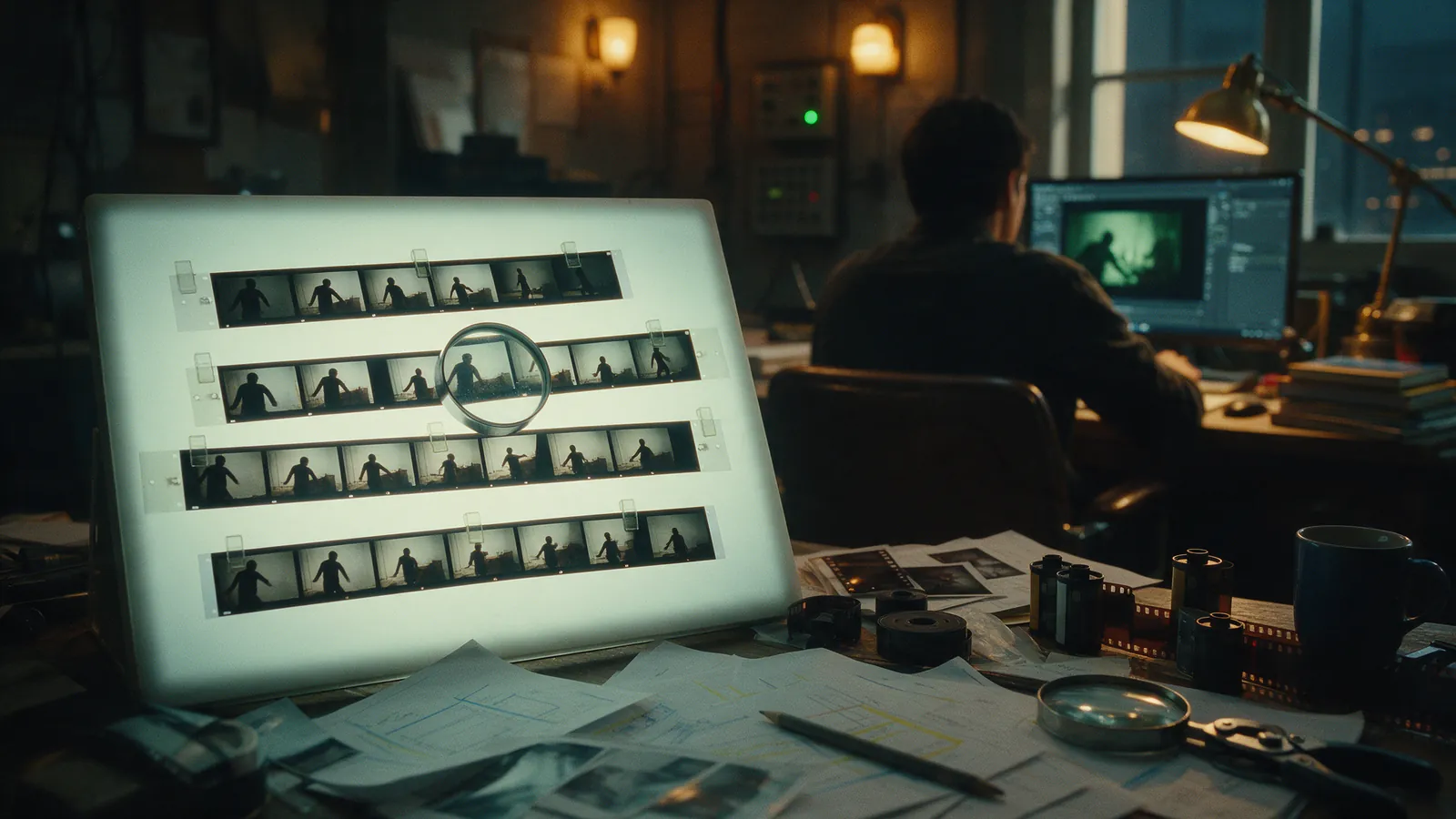
A single corrupted frame can kill the shot. The first frame and last frame are not enough. I review the clip frame by frame before calling it usable.
Image stutter needs the same close inspection. It can come from duplicated frames rather than the frame rate itself.
If I see a stutter, I look for repeated images. I do not assume the problem is frames per second.
This diagnosis changes the next decision. A frame-rate adjustment would not remove duplicated visual information. The batch needs to tell me what actually happened before I regenerate.
Salvage the working seconds
A failed generation can still contain 2 to 5 usable seconds.
That is why I do not delete a variation from consideration as soon as one section breaks. I mark the clean span first.
The opening may work before the face collapses. The middle may contain the correct body performance. The final seconds may hold the location and lighting even if the beginning fails.
Those spans are material.
The cost of the first batch is four variations. The return is not limited to a finished shot. It also includes clean sections, repeated failure patterns, and evidence about which parts of the prompt are already working.
Decide what the second batch must answer
After reviewing all four clips, I should know why I am regenerating.
The next prompt may need clearer body behavior. It may need explicit physics. It may need a stronger camera instruction, the correct character state, or a firmer relationship to the location anchor.
If a name or invented word is spoken, the dialogue can use phonetic spelling, with hyphens and capital letters marking the stress, such as Gan-del-FEE-nah.
That gives the next batch another condition I can hear and compare.
The four-variation method does not promise four chances at luck. It gives me four pieces of evidence. I review them at the level of framing, light, behavior, physics, continuity, space, speech, and individual frames.
Today, generate four variations of one shot and label them diagnostic. Review every frame, record the 2 to 5 second spans that survive, and write the next prompt only after you can name the repeated failure.
A method is what still works on the morning inspiration doesn't show up.