Resources/Template
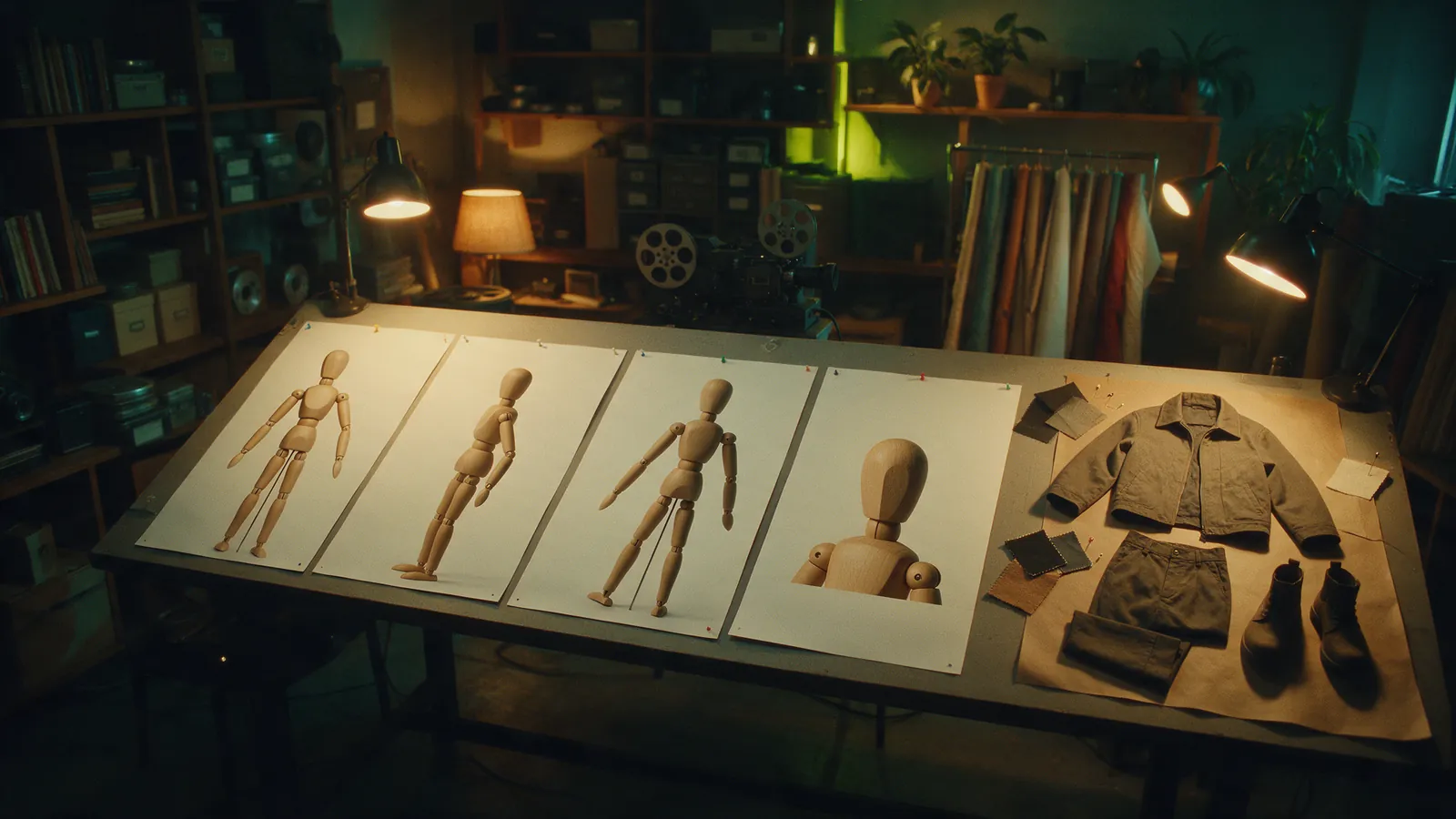
The Four-Panel AI Character Sheet (plus Wardrobe Flat Lay)
My working format for fixing a character's identity and carrying the same clothes into a separate costume sheet.
Who it is for
AI filmmakers who need a character to remain recognisable from every angle.
The problem it solves
A reference can lose its face, proportions or clothing when the model changes the view.
What you get
- Identity worksheet
- four-panel template
- outfit flat lay template
- review checklist
Give the character a stable identity
I want a character reference to make the next image less ambiguous. A face, a front view, a true profile and a back view let me inspect the same person across angles before that person has to carry a performance.
I use this format before generating portraits, costume breakdowns or shots that depend on an established identity. Fill in the identity first, generate the four-panel sheet, inspect it at full size, and only then use it to produce the outfit sheet.
Fill in the identity before generating
Keep these decisions together so the description remains consistent when you prepare another look. Describe visible features precisely, including where they sit, rather than relying on a character's name to produce a face.
| Field | What I write down | Your character |
|---|---|---|
| Face structure | Forehead, cheekbones, jaw, nose, eyes, eyelids and mouth | [Fill in] |
| Named asymmetry | The specific difference that distinguishes this face | [Fill in] |
| Skin marks | Marks and their exact locations | [Fill in] |
| Hair | Colour, length, cut, texture and behaviour | [Fill in] |
| Body | Height, build, hands and feet where visible | [Fill in] |
| Clothing | Each garment from head to feet, including material and colour | [Fill in] |
| Accessories | Position, side and physical attachment | [Fill in] |
| Character palette | The colours carried through the design | [Fill in] |
I keep narrative identity separate from the text that generates a face. The character can have a name in my production notes, while the image description specifies the individual through appearance.
Generate the four-panel sheet
Copy the template and replace the identity field
The layout stays intact: one horizontal image, four views in a row. The portrait establishes the face, while the other three panels share the same body scale and vertical alignment.
Create a professional 4-panel film character sheet in a single horizontal image, with all four panels placed side-by-side and aligned perfectly.
Use the uploaded reference image [IDENTITY REFERENCE IMAGE OR IMAGES] as the absolute identity reference. Preserve the exact same face, facial proportions, hairstyle, skin tone, body type, tattoos, clothing, and distinguishing features in every panel.
PANEL 1 - FACE REFERENCE
Front-facing studio portrait.
Show the entire face clearly, looking directly at camera.
Frame from upper chest to slightly above the hair.
Do not crop the forehead, hair, chin, ears, or sides of the face.
relaxed expression.
Maximum facial fidelity to the uploaded reference.
PANEL 2 - FULL BODY FRONT
Full-body front view.
Character standing naturally, facing directly toward camera.
Arms relaxed at the sides.
Entire body visible from the top of the head to the soles of the feet.
No body parts cropped.
PANEL 3 - FULL BODY SIDE PROFILE
Exact 90-degree side-profile view.
Full body visible from head to feet.
Neutral standing posture.
Arms relaxed naturally.
Do not use a three-quarter angle.
PANEL 4 - FULL BODY BACK
Exact rear view.
Character facing directly away from camera.
Full body visible from head to feet.
Arms relaxed naturally.
SCALE CONSISTENCY
Panels 2, 3, and 4 must show the character at the exact same physical scale, height, and vertical position.
The top of the head and soles of the feet should align horizontally across all three full-body panels.
Do not make the character larger or smaller between views.
Body proportions must remain identical from every angle.
STUDIO SETUP
Professional studio character-reference photography.
Uniform neutral gray seamless background.
Soft, even studio lighting.
Same lighting, exposure, camera height, and color temperature in every panel.
Natural perspective with approximately a 70-85mm portrait lens equivalent to avoid body or facial distortion.
Character centered inside each panel.
LAYOUT
One single final image.
Four equal vertical panels side-by-side.
Clean continuous presentation.
No text.
No labels.
No titles.
No decorative elements.
No props.
No dramatic poses.
No perspective distortion.
No wide-angle lens.
No change in identity.
No change in hairstyle.
No change in wardrobe.
No change in tattoos.
No change in body shape.
The final result should look like the same real person photographed during one professional studio character-reference session from four required angles.

Kodak Vision3 250D, organic film grain, naturalistic photographic film still.
Make only the changes the character needs
- If there is no identity image, replace the reference sentence with the written-description line below, followed by the complete face, body and clothing description. Change the later fidelity sentence to refer to that written description too.
- Remove both mentions of tattoos when the character has none. Naming an absent feature can introduce it.
- Remove the prohibition on props when a specific character state includes something worn or carried that must appear in the sheet.
- Replace the final photographic finish only when the project calls for another finish.
- Keep the same input method and finish across the cast, so one reference does not import a different visual treatment.
Use this written description as the absolute identity reference:
[FACE, NAMED ASYMMETRY, SKIN MARKS, HAIR, BODY AND CLOTHING]
Maximum facial fidelity to the description above.
Review the sheet before using it
I open the image at full size and inspect each panel independently. A thumbnail can hide the difference between a profile and another front view, or an accessory that disappears when the character turns.
- [ ] There are four panels, in the requested order, showing the same person.
- [ ] The face is fully visible, with the requested framing and expression.
- [ ] The third panel is an exact side profile, rather than a three-quarter view.
- [ ] The fourth panel shows the back of the character.
- [ ] All three bodies include the head and feet, at the same height and scale.
- [ ] Hair, body shape, clothing and identifying marks remain consistent.
- [ ] Accessories stay on the correct side and attach in a physically coherent way.
- [ ] The background, lighting and finish belong to the same reference session.
- [ ] The face has been checked for an unwanted resemblance to a recognisable real person.
A repeated change of appearance needs its own sheet. I preserve the base identity and inspect the new state against it, rather than allowing successive edits to redefine the person.
Produce the outfit flat lay from the sheet
Keep the approved clothes as the reference
I attach the character sheet when generating the outfit breakdown. A written costume concept alone leaves room for another interpretation of the clothes; the sheet supplies the garments, colours, cut, wear and details that must carry through.
Fill the concept with garments, fabrics and colours. Leave their positions to the template, which already places the components according to where they are worn.
Create a professional cinematic costume breakdown sheet / wardrobe flat lay for the following concept:

[DESCRIBE THE COMPLETE OUTFIT CONCEPT HERE]

Use the attached character sheet as the absolute wardrobe reference. The costume is exactly the one that person wears in it: reproduce the same garments, with the same colors, fabrics, cut, wear and details, and add no garment or accessory that the person does not wear in the attached sheet.

Present the complete costume disassembled into its individual wearable components, with no character, body or mannequin. Photograph everything from a precise 90-degree overhead view, with the camera perfectly parallel to the surface and minimal perspective distortion.

Arrange the pieces as a coherent full-body wardrobe kit:

* Headwear, helmet or face equipment at the top.
* Upper-body garment centered on the left, front-facing, fully extended.
* Lower-body garment centered on the right, front-facing and vertically extended.
* Gloves or hand accessories placed symmetrically near the sleeves.
* Belt, waist equipment and small accessories positioned near their corresponding anatomical area.
* Footwear displayed as a complete pair along the bottom.
* Any additional layers or wearable equipment placed close to the part of the body where they would be worn.

Every component must be completely visible, uncropped and clearly separated from the others. Maintain consistent proportions, generous spacing and a clean visual hierarchy. Do not overlap, fold, stack or duplicate pieces. All objects must rest naturally on the surface.

Neutral seamless studio background, soft diffused overhead lighting, subtle realistic contact shadows, highly detailed materials and stitching, realistic product photography, professional film wardrobe documentation, clean presentation, vertical 3:4 composition, ultra-high resolution.

No person, mannequin, hangers, clothing rack, labels, annotations, measurements, title cards, decorative typography, environment, dramatic perspective or unrequested props.
Check the clothes against the person
- [ ] Every garment belongs to the attached character sheet.
- [ ] Colours, fabrics, cut, wear and details match the reference.
- [ ] No extra garment or accessory has appeared.
- [ ] The view is directly overhead, in a vertical 3:4 composition.
- [ ] The pieces are complete, separated and visible without overlap.
- [ ] Footwear appears as a complete pair.
- [ ] The image contains the clothes, without a person or mannequin.
Carry the reference forward
I keep the character sheet as the basis for the portrait and outfit breakdown, so those images describe the same design. Before a new look enters a shot, I check that its changes belong to the clothes or the required state, while the person remains recognisable.
Keep going
The AI Film Director's Method: Preparation, Prompts and the Anatomy of a Shot
How I prepare visual references, direct movement and judge what a generated shot actually delivers.
How I Write Seedance Prompts: The Borrowed Wounds Rulebook
A practical structure for turning a shot into visible, timed instructions.
Before You Hit Generate: 20-Point Pre-Flight Checklist for AI Video Prompts
The checks I use to catch avoidable problems while the shot is still a piece of writing.