Build Character Sheets That Give the Clothes as Much Attention as the Face
Build one character sheet per costume, document the headless front view, and approve clothing construction alongside facial identity.
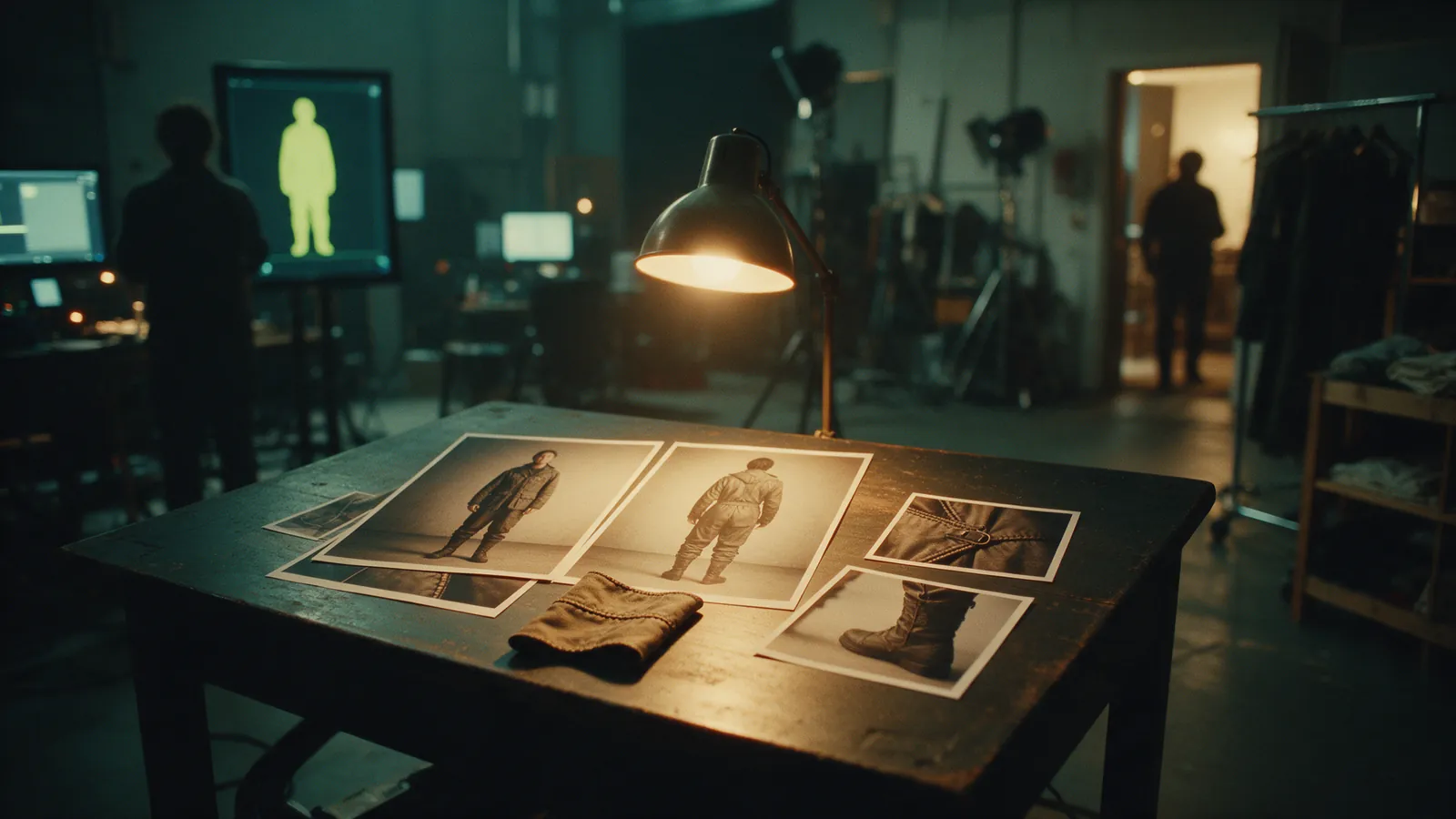
Every character needs one 3:4 character sheet for each wardrobe, plus at least three additional 3:4 views.
That minimum changes what a character sheet is for.
It is not only a face document. It has to preserve the face, body proportions, garment construction, footwear, accessories, closures, seams, hairstyle, and the way the complete outfit sits on the character.
The sheet gives the face one dedicated panel. It gives the clothing two full-body panels.
One of those bodies has no head.
That omission is intentional.
Count every figure that needs continuity
A character is any figure that may appear in frame and needs continuity.
That includes principal and secondary characters, animals, non-animal figures, anthropomorphic characters, extras, and background performers.
The requirement is based on continuity, not narrative status.
If a figure must remain recognizable between shots, it enters the character-reference system.
For each character, the minimum is one sheet per wardrobe and three additional shots. Every image outside the sheet also uses a 3:4 proportion.
This is the first cost to calculate. A character does not equal one image. A character begins with a sheet and supporting views, and every wardrobe change creates another sheet.
Build the sheet as three panels
The character sheet itself is a vertical 3:4 composition on a light-gray studio background.
It contains three panels separated by thin lines.
The portrait fills the entire top third.
The two body views sit side by side and fill the lower two thirds.
This layout prevents the portrait from taking over the whole document. The face gets a large, controlled space, but the body and clothing receive most of the vertical structure.
The three panels also have different jobs. They should not be treated as repeated beauty views of the same character.
Use the top panel for facial identity
The top panel is a frontal portrait.
It shows the face and upper torso in a close-up or short shot. The character faces forward against the light-gray background, under neutral studio light, with a neutral or controlled expression.
This is the primary facial identity reference.
It documents the eyes, nose, mouth, face shape, hair, skin tone, and particular facial traits. Because the face is the purpose of this panel, it includes the required skin-texture clause.
“Done right” means the face is readable without dramatic lighting, an extreme expression, or a scene competing for attention.
The portrait should establish identity. It does not need to carry the entire burden of wardrobe continuity.
That responsibility belongs to the lower panels.
Remove the head from the front body panel
The lower-left panel shows the complete body from the front, beginning at the neck.
The head must not appear.
This is mandatory because the generator tends to spend its attention on the face and resolve the body from memory. Removing the head forces the sheet to document the clothing and proportions that are often lost when a shot is anchored to a bust.
This panel records the fall of the garments, body proportions, footwear, accessories, silhouette, and the front construction of the wardrobe.
Because no face appears, the skin-texture clause is not used here.
The panel may feel strange the first time you build it. It is supposed to. Its purpose is not to produce a complete portrait. Its purpose is to deny the face the attention that belongs to the body and clothes.
I inspect this panel as a wardrobe construction document.
Can I see the full front silhouette?
Are the shoes present?
Are the accessories placed?
Can I understand how the garments fall?
Are the body proportions resolved?
If the answer depends on the portrait above, the lower-left panel has not done its job.
Keep the head in the rear body panel
The lower-right panel is a complete rear view.
Here, the head and hair are visible.
This panel documents the back of the body, the rear construction of the outfit, closures, seams, rear accessories, hairstyle, and the back silhouette.
The front and rear panels are not duplicates. Each one carries information the other cannot show.
A front view cannot define a rear closure.
A portrait cannot document the full hairstyle from behind.
A three-quarter scene image cannot replace a controlled rear view when the back of the costume needs to remain consistent.
“Done right” means the rear panel resolves the complete shape from head to footwear and exposes the garment details that disappear from the front.
Make one sheet for every wardrobe
The sheet is tied to a costume, not only to a character name.
If a character has street clothing, a uniform, party clothing, work clothing, and pajamas, that character needs five sheets.
Each look gets its own three-panel document.
Meaningful narrative variants also remain separate. A clean uniform, dirty uniform, worn uniform, and bloodied uniform each require their own reference.
This is where wardrobe changes create real production work.
A new costume does not add one accessory image to the existing character sheet. It adds another complete sheet because the facial identity and that wardrobe need to be documented together.
The unit is not simply “the character.”
It is “the character in this wardrobe.”
Approve the face and the clothing separately
A character sheet can succeed in one area and fail in the other.
The portrait may preserve the face while the front body panel leaves the clothing vague. The rear panel may show a strong silhouette while changing the hairstyle or hiding the closures.
I do not approve the sheet as one undifferentiated image.
I approve the facial identity in the top panel. Then I approve body proportions and garment construction in the lower panels.
The headless front view is especially useful here. It makes it harder to excuse weak clothing because the face looks good.
The face and costume have different continuity requirements. The sheet must satisfy both.
Add the three required supporting views
The sheet is the minimum foundation, but it is not the complete reference package.
Each character also needs at least three additional 3:4 shots.
The first is a centered frontal face view. It fixes the eyes, nose, mouth, face shape, hair, skin tone, and distinctive facial traits. It includes the skin-texture clause.
The second is a half-body view, framed from the waist or middle torso upward. It consolidates posture, proportions, the upper fall of the clothing, and the relationship between face, body, and wardrobe. It also includes the skin-texture clause.
The third places the character inside a situation from the project’s world while preserving the approved identity. Its job is to test whether the character works inside that world. It includes the skin-texture clause when the face appears close enough to require it.
These images are not replacements for the three-panel sheet.
The frontal face view strengthens identity.
The half-body view checks how the upper costume and character fit together.
The scene view tests the approved design in context.
Each adds evidence that the sheet alone cannot provide.
Treat each wardrobe as a complete character reference
A sheet already includes the character wearing the costume.
That has an important consequence for shot prompting. The reference is no longer only “the character,” with a separate wardrobe instruction competing beside it. It is the character in the uniform or the character in street clothes.
The prompt therefore invokes one sheet, not two.
The earlier approach required naming the character and the wardrobe separately. Those two references could become unsynchronized.
A wardrobe-specific character sheet removes that split. The face, body, and outfit travel together inside one approved reference.
This does not reduce the preparation work. It moves the work earlier, where it can be inspected.
Each wardrobe must already have its own completed sheet.
Understand the cost of a costume change
The minimum cost of one wardrobe is one three-panel sheet plus three additional 3:4 views.
A second wardrobe requires another sheet. A meaningful state variant also requires a separate reference.
I never logged a price or generation-time estimate, so I do not reduce this to money or hours. The measurable cost is the number of required assets.
Every new look adds reference work.
Every meaningful clothing state adds more.
That cost should be recognized when deciding how many costumes a character carries. A wardrobe change affects more than the scene in which it appears. It changes the character package used to preserve continuity.
Use an approval order
I approve the package in a fixed sequence.
First, I check the top portrait for facial identity and skin texture.
Second, I check the headless front body for body proportions, garment fall, footwear, accessories, front silhouette, and clothing construction.
Third, I check the rear body for hair, closures, seams, rear accessories, and back silhouette.
Fourth, I inspect the separate frontal face view.
Fifth, I inspect the half-body relationship between face, posture, body, and clothing.
Sixth, I test the character in the project’s world through the scene view.
This order keeps a good portrait from hiding an incomplete outfit. It also prevents an attractive scene image from replacing the controlled reference views.
“Done right” means the face is approved, the front and rear clothing construction are readable, and the supporting images confirm that the combined character works beyond the sheet.
Today, take one existing character sheet and inspect its front body view. If the face is taking attention away from the clothes, rebuild that panel from the neck down and make the wardrobe carry the image.
A method is what still works on the morning inspiration doesn't show up.