How One Duel Shot Splits References Across Characters, a Sword, and a Location
A 14-second duel prompt shows how two characters, one sword, and one location divide the reference work.
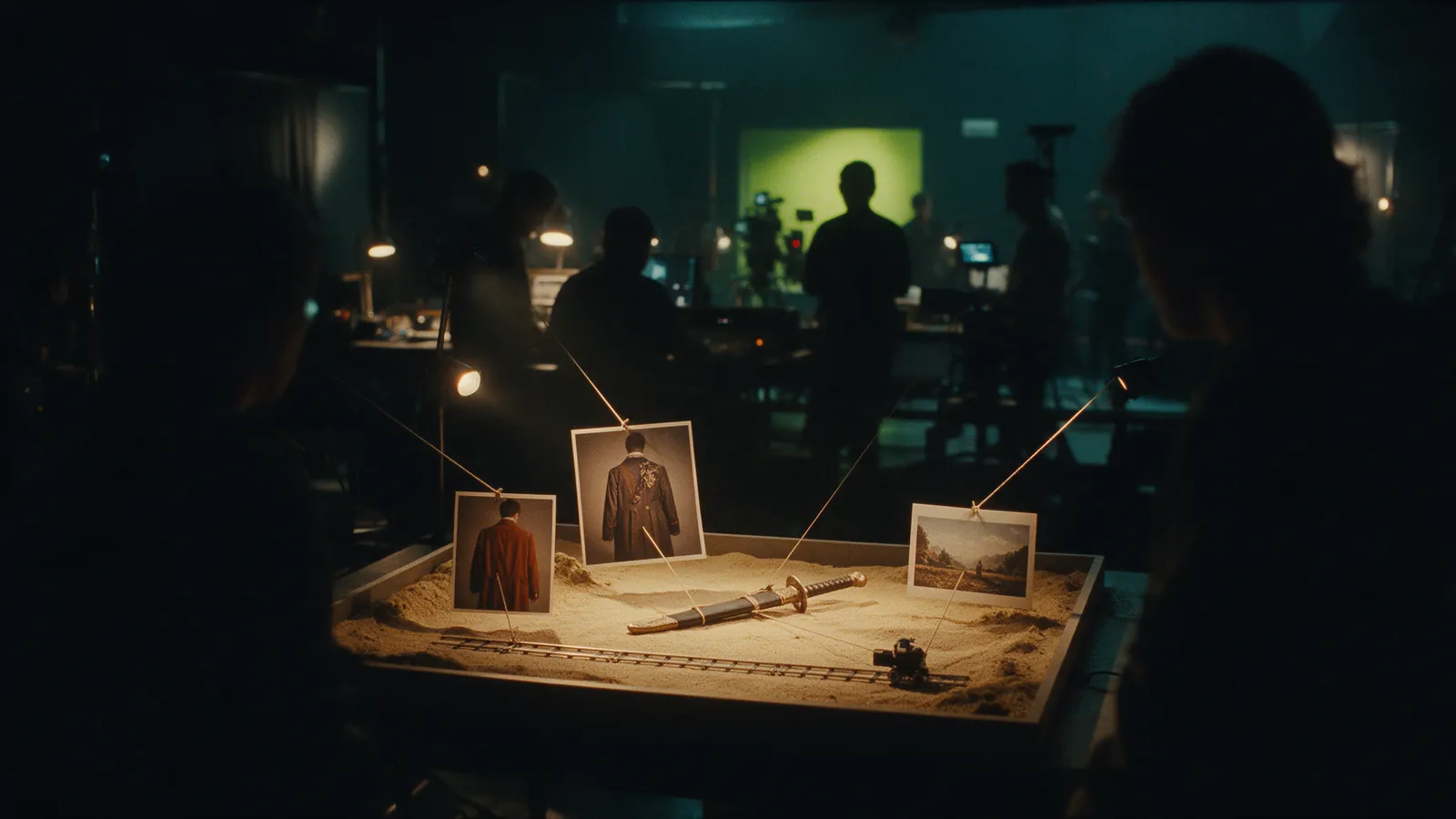
The duel shot uses four active references: two characters, one sword, and one dawn location.
That sounds like a list. It is actually a division of responsibility.
Each reference controls a different part of the shot. The two character references identify the fighters. The prop reference defines one specific sword. The place reference establishes the raked sand, dawn light, and pine line.
The prompt then binds those four references to blocking, framing, movement, action, and physical detail. Without that second layer, the references would be present, but their jobs inside the shot would remain vague.
The four references
The prompt opens with the situation and then names the active references:
SCENE CONTEXT
Dawn duel on raked sand, already under way. Two swordsmen close the last four metres and their blades meet three times in fourteen seconds. The camera lives inside the fight and catches it only in fragments.

ACTIVE REFERENCES
@character-toshiro-mabe-formal: man in his forties, black formal robe, dry and unmarked. 100% matches the reference.
@character-ryo-sagi-brown: man in his thirties, brown robe, dry and unmarked. 100% matches the reference.
@prop-mabe-sword: single-edged sword, worn cord wrap on the grip. 100% matches the reference.
@place-sand-ground-dawn: raked sand ground at dawn with a pine line behind it. 100% matches the reference.
The scene has to cover the last four meters of the approach, three blade contacts, and fourteen seconds. The camera is inside the fight and receives the action in fragments.
The character references are not treated as a shared style board. Each one has a separate identity and wardrobe state.
Toshiro Mabe is the man in his forties wearing a black formal robe. Ryo Sagi is the man in his thirties wearing a brown robe. Both are dry and unmarked.
Those descriptions give the shot immediate visual separation. Black belongs to one man. Brown belongs to the other. Their ages also remain attached to their individual reference names.
The sword gets its own category. It is not described as a generic weapon carried by either fighter. It is Mabe’s single-edged sword with a worn cord wrap on the grip.
The location gets the fourth category. It establishes raked sand at dawn and a pine line behind the action.
At prompt level, removing any one of these references removes a specific binding. Remove a character reference and one fighter loses his stated identity. Remove the prop reference and the sword loses the single edge and worn grip wrap. Remove the place reference and the ground, time of day, and pine line are no longer tied to their plate.
The archive behind the shot
The reference library contains 144 images before counting the storyboard.
Ninety-three are character images spread across nine folders. Thirty-six are place images across five locations. Fifteen are object images across six objects. The storyboard adds 146 panels, but those are not included in the 144-image reference total.
The library is already divided by the same categories used in the duel prompt.
The character folders include 17 images for Rokuro Hane, 18 for Sadao Kiri, 16 for Kaoru Ide, 10 for Tsune Mori, nine for Ino Tabe, eight for Ryo Sagi, eight for Toshiro Mabe, five for Hane’s marked torso, and two for the eagle.
For places, I have 12 arena images at dawn, 12 arena images at midday, six for the exit road, three macro images of raked sand, and three images of the trampled strip of earth.
For objects, I have three linen cloth images, three tournament scroll images, three wooden easel images, two images of Kiri’s sword, two of Mabe’s sword, and two of knee marks.
The duel prompt selects only what this shot needs from that larger library. It does not call every available character, place, or prop image into the shot. It activates two fighters, one named weapon, and one version of the arena.
That selection keeps the reference roles readable.
The location reference needs a spatial map
The place plate gives the prompt a dawn arena. The location map tells the shot how to use it:
LOCATION MAP
Foreground: sand kicked up at ankle height, drifting across the lens. Midground: the two men, four metres apart on the first frame and closing. Background: the pine line and a row of standing onlookers, soft and small. The camera sits between the two men at chest height, 1.5 to 4 metres out. Colour lives in the materials: pale dry sand, black wool robe, brown hemp robe, cold grey steel, all of it lit warm from one side.
The foreground belongs to kicked sand.
The midground belongs to the two fighters.
The background belongs to the pine line and the onlookers.
That map connects the place reference to depth. It also connects the character references to the midground and the prop reference to the cold gray steel inside the palette.
The camera gets a physical position: between the two men, at chest height, from 1.5 to 4 meters away.
The material colors repeat the reference split. Pale dry sand belongs to the location. Black wool and brown hemp belong to the two fighters. Cold gray steel belongs to the weapon. Warm light comes from one side.
Without the location map, the active references would still name the right assets. They would not state which one occupies the foreground, midground, or background.
Blocking binds identity to direction
The first frame tells each character reference where to enter and where to travel:
FIRST FRAME / BLOCKING
Both men are already at a full run, mid-stride, weight forward, blades up and travelling. @character-toshiro-mabe-formal enters frame left moving right; @character-ryo-sagi-brown enters frame right moving left. Sand is already in the air. Tight two-shot, cut off at mid-thigh.
Toshiro enters from frame left and moves right.
Ryo enters from frame right and moves left.
Both are already running. Their weight is forward. Their blades are moving. Sand is already airborne. The framing is a tight two-shot cut at mid-thigh.
This block does more than request motion. It assigns that motion to the references by name.
If I only wrote that two swordsmen run toward each other, I would not have specified which referenced man starts on which side. Here, identity and screen direction are part of the same sentence.
That matters because the camera will whip between them. The prompt establishes the initial orientation before the camera begins moving through the fight.
One camera has to carry all four references
The format and camera blocks keep the duel in one continuous shot:
FORMAT MODE
One continuous shot, the camera holds the take to the last frame. Fast lateral whips inside the shot are camera movement.

OPTICS
Tight two-shot at 63°, opening to 47° as the gap closes. Natural perspective, shallow separation on the near body, deep focus held on the far one.

CAMERA
Handheld at chest height, 1.5 to 4 metres from the bodies, moving with the fight instead of following it. It takes each impact in the frame, whips laterally between the two men, and arrives a fraction late to every clash, so each blow is already leaving as the frame gets there. Focus rides the near shoulder.
The lateral whips are camera movement inside the take. They are not cuts.
The frame begins as a tight two-shot at 63 degrees and opens to 47 degrees while the distance closes. The near body receives shallow separation. The far body stays in deep focus.
The camera remains at chest height, between 1.5 and 4 meters from the fighters. It moves with the fight, takes each impact, and arrives a fraction late to every clash. Focus rides the near shoulder.
That camera design forces the references to coexist under movement. The near fighter can change as the camera whips, but both character identities still have named roles. The weapon has to remain attached to Mabe. The dawn arena has to survive in the sand and pine background.
Time divides the physical work
The action is split into four timed sections:
ACTION
0 to 4 seconds: both men cover the last four metres at running speed and the blades meet the first time, steel on steel, and slide apart.
4 to 8 seconds: the second exchange, closer, with the camera whipping across to the far man as his hips turn into the cut.
8 to 11 seconds: the third clash, the tightest of the three, the two guards locked for a fraction of a second at chest height.
11 to 14 seconds: they break and the next attack is already loading, and the shot ends with that movement still travelling.
The references do not replace choreography. They tell the shot who and what must remain recognizable while the action advances.
The first four seconds close the four-meter gap and deliver the first contact. The next four move closer and carry the camera toward the far man. The next three contain the tightest clash. The last three break the fighters apart while the next attack is already loading.
The shot ends during motion.
The practical lesson is to assign reference jobs before describing movement. Today, take one moving shot and label every input as character, prop, or place. Then bind each label to a side of frame, a depth layer, and a timed action.
You just watched one shot come apart, decision by decision. None of them landed there by luck.