Resources/Checklist
The Generated Shot Audit: How to Review an AI Clip Frame by Frame
A practical review sheet for finding the moment a generated shot stops making physical sense.
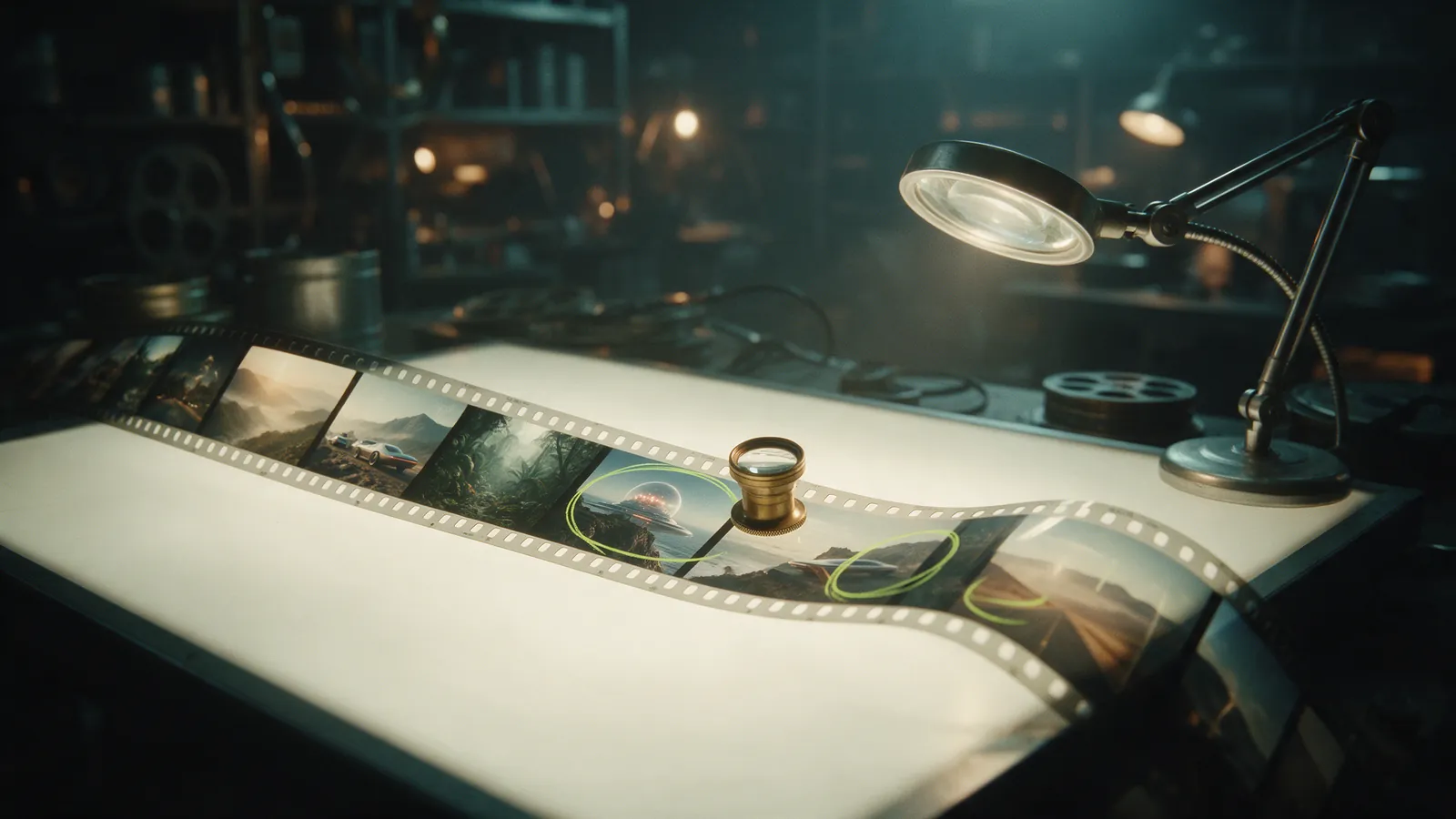
Who it is for
For filmmakers deciding whether a generated clip works, needs correction or cannot yet be judged.
The problem it solves
Watching a clip straight through can conceal failures of identity, contact, space and timing.
What you get
- Fifteen inspection passes
- evidence fields
- correction map
- four-part verdict template
Judge what the image proves
I use this audit after a clip has been generated, when I need to understand why it works or where it breaks. It turns an impression into observations that another person can check against the same frames.
A shot can pass one test and fail another, so I keep the findings separate. When the image does not provide enough detail to judge, I mark the result inconclusive instead of turning missing evidence into approval or rejection.
Prepare the review sheet
Fill these fields before assigning a verdict, then use the relevant passes below. Keep each observation tied to a visible event rather than a general description of quality.
| Field | Your entry |
|---|---|
| Intended use | [Where the clip will appear.] |
| Viewing context | [Screen size, crop and subject scale.] |
| Test | [The physical behaviour being checked.] |
| Visible evidence | [What happens before, during and after the failure.] |
| Finding | [Works, fails or inconclusive, with the reason.] |
| Correction target | [The reference or instruction that needs attention.] |
Inspection passes
1. Describe the camera's path
- [ ] I can name what the camera physically does and trace its route.
Use verbs such as pushes, rises, falls, orbits and settles. The source example is an orbit of 120 degrees around the subject at chest height: it specifies a path, whereas “dynamic shot” leaves the movement undefined. If your description only says the shot changes, inspect whether you are seeing movement or a jump.
2. Follow two anchors
- [ ] One subject detail and one scene detail remain coherent as the viewpoint changes.
Choose, for example, a torn sleeve and a column. If the sleeve survives while the column's position becomes impossible, investigate the space; if the column remains coherent while the sleeve changes, investigate identity. Record which anchor fails rather than treating both problems as the same defect.
3. Inspect what each cut conceals
- [ ] I have checked the action immediately before and after every suspicious cut.
Look for the next movement the camera or body would have needed to complete. Three cuts landing at contact can reveal a repeated difficulty, while one isolated cut does not establish a pattern. When the same instant keeps disappearing, consider giving that action its own shot instead of expanding a long description.
4. Separate optical behaviour from an overlay
- [ ] Distortion changes with distance from the camera.
In the source example, a nearby hand grows strongly under a wide-angle view, the face changes less and the distant setting changes least. A curved border around an otherwise flat subject does not demonstrate that depth response. Record which distances behave differently before blaming the overall look.
5. Track identity, then timing
- [ ] A recognisable detail survives changes of setting, wardrobe or framing.
- [ ] Mouth, arm, reflections and cuts belong to the same temporal rhythm.
Glasses or a metallic shirt can provide the recognisable detail. Inspect its continuity first, then compare the mouth movement, arm movement and highlights: individually plausible elements can still look like separate layers when their timing disagrees.
6. Read the expression as a sequence
- [ ] Preparation, maximum effort and release are visible when the performance calls for them.
The source gives a clenched jaw, a two-second hold, an exhale and lowered shoulders as a directed sequence. A sustained tense face does not show that development. If the face is too small to inspect, mark expression and lip synchronisation inconclusive rather than claiming they work.
7. Inspect choreography at three moments
- [ ] Entry begins from believable balance and joint positions.
- [ ] Contact preserves separate bodies and limbs.
- [ ] Recovery continues naturally instead of resetting.
A repeated movement makes comparison easier because the same physical problem returns. On a reflective floor, compare the reflection at those same moments; disagreement between body and reflection is visible evidence. If an edit hides contact, inspect the approach and recovery for a sudden return to the earlier pose.
8. Follow a transformation's consequences
- [ ] The before, changing body, resulting damage and return connect into one event.
The source example leaves fallen embers as debris after the figure returns to its original form. If the setting becomes clean again, the sequence has shown separate states without preserving their consequences. List what must remain stable across all four phases before judging the transformed design itself.
9. Examine contact and support
- [ ] The contact frames explain position, weight and the transfer to a supporting surface.
The source follows a handheld phone being placed on a stone: wrist movement before contact, support at contact and the frame settling afterwards. In this pass, judge only whether the camera movement agrees with the hand and surface. Record an unrelated face or synchronisation problem separately so it does not replace the contact test.
10. Compare the screen within the screen
- [ ] A monitor showing the action agrees with the larger scene.
When a wider view reveals production monitors displaying the same event, compare both scales. The action must remain coherent in the scene and in its displayed image; attractive detail on the smaller screen does not compensate for disagreement about what is happening.
11. Test depth during fast movement
- [ ] Near, middle and distant elements change size coherently under one camera movement.
Use the source case of a rapid camera retreat to inspect depth. People in the middle distance may pass too quickly and distant detail may break, so counting background objects tells you little. Compare their relative changes rather than rewarding the shot for having a crowded setting.
12. Recheck every reverse shot
- [ ] Eyelines preserve who is looking at whom.
- [ ] Light direction and flicker remain credible.
- [ ] The reaction develops instead of returning to a neutral expression.
In dialogue, inspect these separately on each return. A face resetting to neutral is a performance finding; a reversed eyeline is a spatial finding. Keeping them separate makes the correction more specific than saying the conversation feels wrong.
13. Orient yourself inside an unusual world
- [ ] A person, an object, a movement and a light source remain readable.
Freeze the busiest frame and identify the floor, the direction of machinery and the source illuminating the face. These are the source's orientation tests for a surreal setting. An unusual premise still needs stable relationships that allow the viewer to understand the image.
14. Review at delivery scale
- [ ] I have checked the intended screen size, crop and subject scale.
The source contrasts softness that disappears on a phone with softness visible on a television or in a wide crop. Inspect the actual product before promising its delivery format, rather than relying on a demonstration's resolution label. A small preview cannot settle a large-screen judgement.
15. Write a bounded verdict
- [ ] My verdict names both the capability and its limit.
The source example accepts an orbit for a vertical social cut but not a festival projection, because identity and light remain coherent while facial detail in the wide shot does not withstand the larger display. Use that relationship between evidence and destination, without assuming every failure rules out every use.
Complete the four-part report
| Report field | Fill in |
|---|---|
| Capability | [The demanding test this result passes.] |
| Limit | [The visible failure or unjudgeable detail.] |
| Context | [The screen and crop in which it will be seen.] |
| Verdict | [The use it supports and the use it cannot support.] |
Write the final sentence from these fields: I would use this result for [destination], but not for [unsuitable destination], because [visible evidence] remains coherent while [specific limitation] does not.
Return the finding to the shot instructions
| Visible problem | Correction target |
|---|---|
| Identity changes | The character reference image. |
| Space breaks during a turn | Scene anchors and their persistence. |
| Optical effect stays flat | Lens description, subject distance and depth response. |
| Cuts repeatedly hide contact | Shot scope and a separate contact shot. |
| Expression stays frozen | Preparation, effort and release. |
| Transformation erases its aftermath | Consequences that remain visible. |
| An object seems weightless | Support, weight and settling. |
When an instruction has been ignored, I move it earlier rather than repeating it at the end. The correction should address the observed failure, not make every part of the prompt longer.
Keep the evidence visible
I accept a shot for what it can demonstrably sustain at its intended viewing size. When the evidence is insufficient, an inconclusive finding keeps the next decision honest.
Keep going
When AI Video Breaks: Real Failures and How I Fixed Them
A filmmaker's account of the failures behind generated images, moving performances, and the checks that made the work usable.
The AI Film Director's Method: Preparation, Prompts and the Anatomy of a Shot
How I prepare visual references, direct movement and judge what a generated shot actually delivers.
How I Write Seedance Prompts: The Borrowed Wounds Rulebook
A practical structure for turning a shot into visible, timed instructions.